



If you’re running a business, you’re constantly looking for ways to reach new customers and grow your brand. While you may have considered social media or paid ads, one of the most powerful and sustainable tools at your disposal is a business blog. This guide will teach you why a blog is crucial for your business and provide a step-by-step plan to start writing content that attracts and converts customers, even if you’re a complete beginner.

What is Business Blogging and Why Does It Matter?
At its core, business blogging is the practice of creating and publishing content on a blog to attract your target audience. It’s not about writing a direct sales pitch in every post. Instead, the primary goal is to provide genuine value by answering your audience’s questions, solving their problems, and sharing your expertise. By consistently offering helpful information, your blog builds trust and establishes your company as an authority in your industry, making customers more likely to choose you when they’re ready to buy.
The Top 7 Benefits of Blogging for Your Business
Investing time into a blog delivers significant returns across your entire business. Here are the most impactful benefits you can expect:
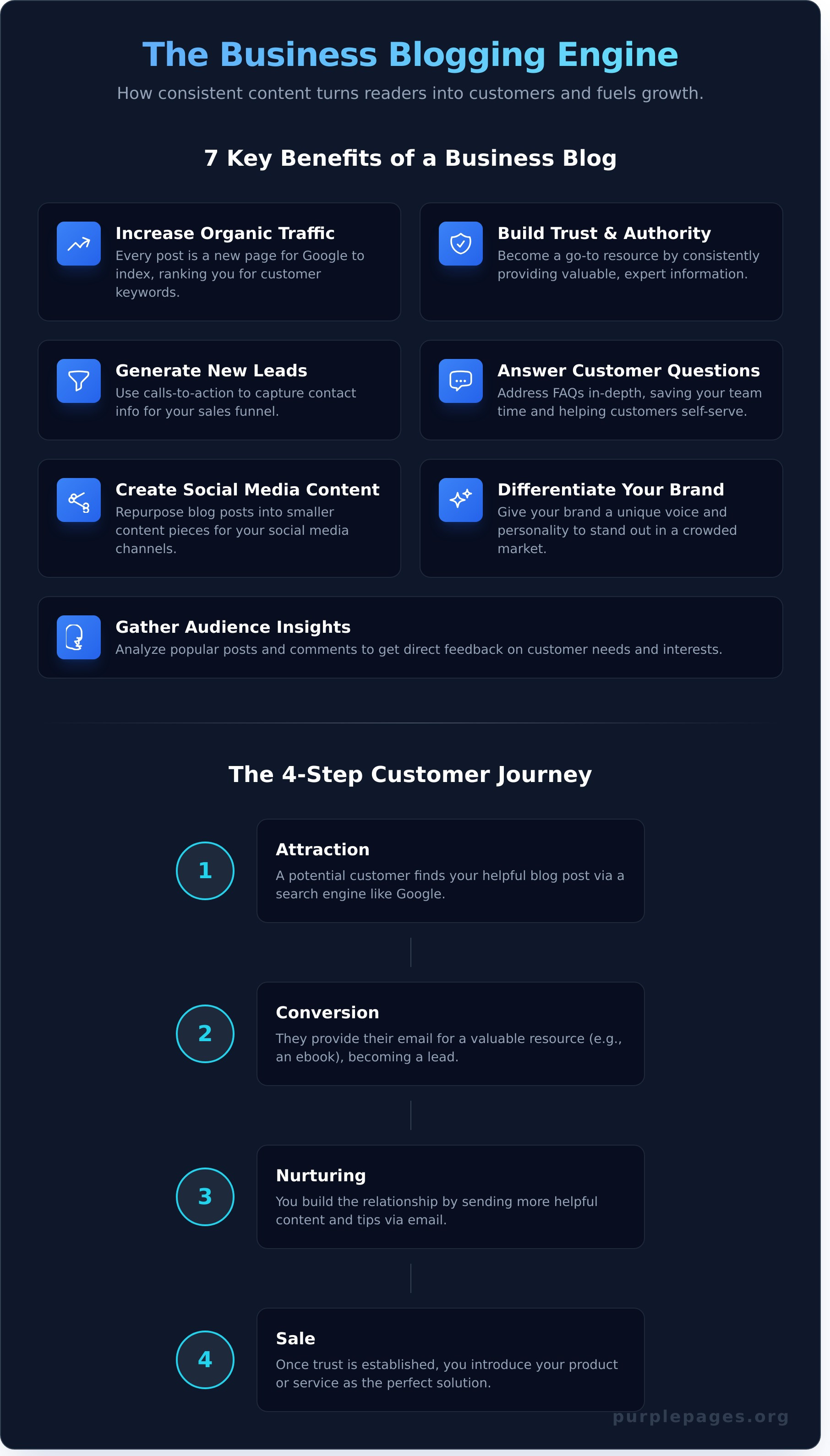
- Increase organic website traffic through SEO: Every blog post you publish is a new page that search engines like Google can index, giving you another opportunity to rank for keywords your customers are searching for.
- Build trust and establish yourself as an industry expert: By consistently providing valuable, accurate information, you demonstrate your expertise and become a go-to resource for your audience.
- Generate new leads for your sales funnel: You can include calls-to-action within your posts that encourage readers to exchange their contact information for a valuable resource, like an ebook or webinar.
- Answer common customer questions at scale: A blog allows you to address frequently asked questions in-depth, saving your team time and helping customers self-serve.
- Create content for your social media channels: Blog posts can be easily repurposed into smaller pieces of content for platforms like LinkedIn, Facebook, and Twitter, keeping your social feeds active and engaging.
- Differentiate your brand from competitors: A blog gives your brand a unique voice and personality, helping you stand out in a crowded market.
- Gather insights on what your audience cares about: Analyzing which posts are most popular and what questions are asked in the comments provides direct feedback on your customers’ needs and interests.
How a Blog Post Turns a Reader Into a Customer
It can be hard to see the direct line from a blog post to a sale, but it works through a process known as a marketing funnel. Here’s a simple breakdown of the journey:
- Attraction: A potential customer has a problem or question. They type it into Google and find your helpful blog post that provides the answer.
- Conversion: Within the post, you offer a free, related resource, like a detailed checklist or guide. To get it, the reader provides their email address, becoming a lead.
- Nurturing: Now that they are on your email list, you can continue to build the relationship by sending them more helpful content and tips over time.
- Sale: Once you have established trust and demonstrated your value, you can introduce your product or service as the perfect solution to their problem. Because they already know and trust you, they are a warm lead and much more likely to buy.
How to Start a Business Blog: A 5-Step Guide
Launching a blog is more straightforward than you might think. You don’t need to be a technical wizard or a professional writer to get started. Follow these five foundational steps to build a blog that gets results.
Step 1: Define Your Blog’s Purpose and Audience
Before you write a single word, you need to know who you’re writing for and what you want to achieve. Ask yourself: Who are you trying to reach? Be specific (e.g., “small business owners in the retail industry,” not just “businesses”). Next, identify what problems your blog will solve for them. Finally, set simple, measurable goals, such as generating 10 new leads per month or increasing website traffic by 20% in six months.
Step 2: Choose Your Blogging Platform and Set It Up
You need a place for your blog to live online. Popular and user-friendly options include WordPress, Squarespace, and Wix. Whichever you choose, invest in a professional domain name (e.g., yourbusiness.com) rather than using a free subdomain. When designing your blog, keep the layout simple, clean, and easy to read, with a focus on making your content the star.
Step 3: Brainstorm Your First Content Ideas
Staring at a blank page can be intimidating. To generate ideas, start by listing the top 10 questions your customers always ask you. Each of these can be a blog post. You can also look at what your competitors are writing about to identify popular topics or find gaps you can fill. Free tools like Google Trends can also show you what people in your industry are searching for.
Step 4: Write and Optimize Your First Post
When you write your first post, focus on being helpful and clear. Start with a title that accurately describes what the article is about. Use short paragraphs, clear headings, and bullet points to make the text easy to scan. Most importantly, include one clear call-to-action (CTA) at the end that tells the reader what to do next.
Step 5: Promote Your Content
Hitting “publish” is not the final step. You need to promote your content to get it in front of readers. Share your new post on your company’s social media profiles. If you have an email list, even a small one, send the article to your subscribers. Consistent promotion is essential for getting initial traction and building an audience over time.
Common Business Blogging Mistakes to Avoid
Starting a blog is easy, but sticking with it requires avoiding common pitfalls that cause many businesses to give up too early. By being aware of these mistakes, you can set yourself up for long-term success and see results faster.
Writing Only About Your Products or Services
The biggest mistake businesses make is treating their blog like an advertisement. A successful blog should be 90% helpful and only 10% promotional. Always focus on your customer’s problem first, not on your solution. When you build trust by providing value, the sales will follow naturally.
Inconsistent Publishing
Consistency is more important than frequency. It’s far better to publish one high-quality post every month than to publish four posts one week and then nothing for the next two months. Create a simple content calendar—even a basic spreadsheet—to plan your topics and schedule your posts to stay on track.
Ignoring SEO (Search Engine Optimization)
You don’t need to be an SEO expert, but ignoring it completely means you’re missing out on free traffic from search engines. For each article, identify the main keyword or phrase someone would use to find it. Make sure you use this keyword in your title, your introduction, and a few times throughout the article naturally.
Not Having a Call-to-Action
Every blog post needs a purpose. If you don’t tell the reader what to do next, they will simply click away and forget about you. Your call-to-action should guide them to the next step, whether it’s downloading a guide, contacting you for a quote, or reading another related article. A great blog post educates, and a great CTA empowers the reader to act on that education. Ready to share your own expertise? Contribute to our blog!
Blogging for Business FAQ
How often should a business post on its blog?
For most small businesses, starting with one to two quality posts per month is a sustainable and effective goal. Consistency is more important than high volume.
How long does it take for a business blog to be successful?
Blogging is a long-term strategy. It typically takes at least 6 to 12 months of consistent effort to see significant results in traffic and lead generation.
What is the difference between a blog and a website?
A website is typically made of static pages that don’t change often (like a homepage or services page). A blog is a part of a website that is updated regularly with new articles (posts) displayed in reverse chronological order.
Can I use AI to write my business blog posts?
AI tools can be helpful for brainstorming ideas and creating outlines, but the content should always be reviewed, edited, and infused with your unique human expertise and brand voice to build genuine trust with your audience.
How do you make money from a business blog?
A business blog primarily makes money indirectly by attracting potential customers and converting them into leads for the company’s products or services. It supports the sales process rather than generating direct revenue.
Starting a blog is one of the most effective ways to build a long-term asset for your business. By providing value and building trust, you can create a reliable engine for traffic, leads, and sales. The key is to start simple, stay consistent, and always focus on helping your reader. If you have valuable insights to share, a platform is waiting. Share your business expertise with our readers. Write for us!